Days to Hours

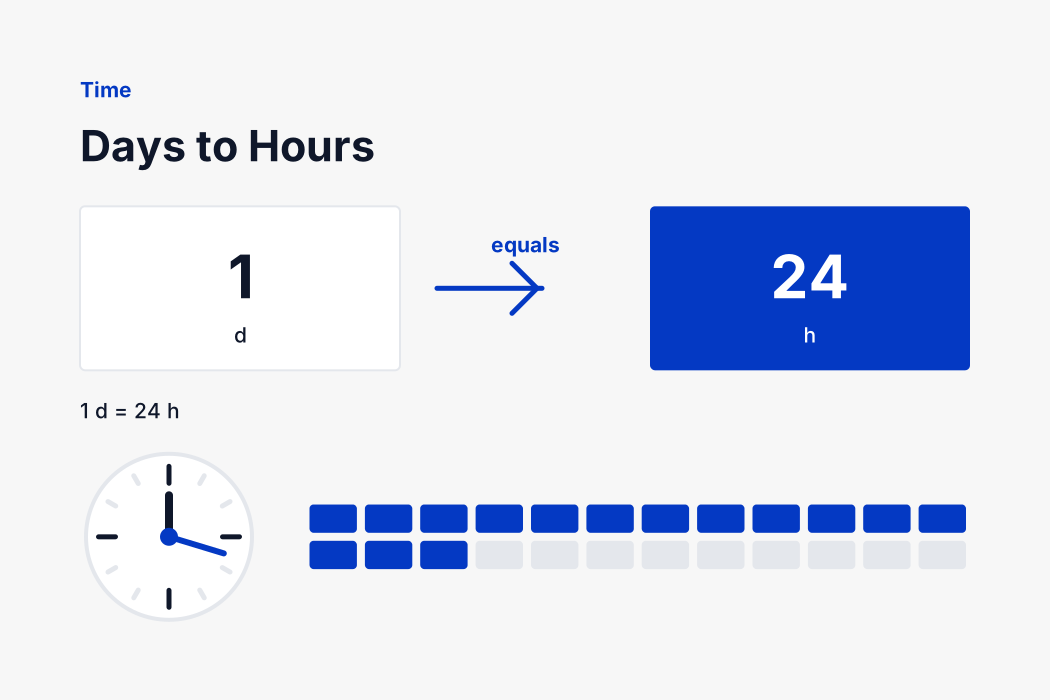
1 d = 24 h

Exact factor Nothing uploaded Works offline No sign-up
d
h

1 d = 24 h

Quick values

Twenty four, with two exceptions a year

A day is twenty four hours, and this is the simplest conversion on the site. The interesting part is the two days each year when it is not true, in any country that observes daylight saving time.

On the day the clocks go forward, the calendar day is twenty three hours long. On the day they go back it is twenty five. If you are scheduling machinery, calculating shift pay or writing software that adds twenty four hours to a timestamp, those two days will produce a wrong answer once each year.

There is also a distinction between a calendar day and a solar day, which is about four minutes shorter, and the astronomical sidereal day of 23 hours 56 minutes. None of them affect a schedule, but they are why leap seconds exist.

A calendar page beside a clock showing a multi day duration in hours
How it works

Type, read, done

There is no convert button and no page reload. The answer updates on every keystroke.

1

Type your figure

Put a number of days into the left box. Decimals, negatives and very large values all work.

2

Read the answer

The hours figure appears as you type, along with the full sentence underneath so you can copy it whole.

3

Adjust or reverse

Change the decimal places, tap a quick value, or press swap to convert hours back to days.

The formula

A calendar day is twenty four hours by convention. The exception is the two days a year when a country moves its clocks for daylight saving, which are 23 and 25 hours long.

h = d × 24

To go the other way: d = h ÷ 24

Worked through with a real number, 7 d becomes 168 h. The calculation at the top of the page runs the same arithmetic as you type, to as many decimal places as you ask for.

Days to Hours conversion chart

Every value below is calculated with the exact factor rather than a rounded one, then displayed to 2 decimal places. Read it on screen or print the page, since the chart carries no scripts and needs no connection.

DaysHoursDaysHours
0.5 d12 h14 d336 h
1 d24 h20 d480 h
2 d48 h21 d504 h
3 d72 h30 d720 h
5 d120 h60 d1,440 h
7 d168 h90 d2,160 h
10 d240 h365 d8,760 h

The values people look up most

These are the days figures that get searched for by name, worked out with the exact factor rather than a rounded one.

  • 0.5 d is 12 h.
  • 2 d is 48 h.
  • 5 d is 120 h.
  • 10 d is 240 h.
  • 20 d is 480 h.
  • 30 d is 720 h.

Anything not on this list can be typed into the converter at the top of the page, which handles decimals, very large numbers and negative values without rounding until you ask it to.

Common durations in hours

The figures that come up in project planning, service level agreements and travel.

  • 1 day is 24 hours.
  • 2 days is 48 hours, the most quoted delivery window there is.
  • 3 days is 72 hours, the standard visa and test validity window.
  • 7 days is 168 hours, a full week.
  • 14 days is 336 hours, a two week quarantine or notice period.
  • 30 days is 720 hours, the usual billing month.
  • 365 days is 8760 hours, a non leap year.

Service agreements often distinguish business hours from clock hours, so a 48 hour response time may mean two working days rather than two calendar days. Check which the contract means before counting.

Sixty, twenty four and why they stuck

The hour of sixty minutes comes from Babylonian mathematics, which counted in base sixty because sixty divides cleanly by two, three, four, five, six, ten, twelve, fifteen, twenty and thirty. That made fractions easy in an era without decimals, and it is the reason a circle has 360 degrees as well.

The twenty four hour day came from Egypt, where ten daylight hours were bracketed by twilight and matched by twelve at night. Neither number has any physical basis, and both have survived every attempt to replace them, including the French revolutionary decimal clock of ten hours to the day.

Converting days to hours therefore uses a factor of 24 that is pure convention rather than measurement, which is why it is the one conversion on this site that has never been revised by a standards body.

Where a days conversion stops being simple

Time is arithmetically the easiest family here and practically one of the trickiest, because the units are exact but the calendar is not. Sixty minutes to the hour never varies. Twenty four hours to the day varies twice a year anywhere daylight saving is observed.

Months are worse. A billing month is usually thirty days, a calendar month is anything from twenty eight to thirty one, and a working month depends on where the weekends fell. Any conversion involving months should state which definition it used, because the spread is more than ten percent.

For contracts and service agreements, the distinction that causes most argument is business hours against clock hours. A forty eight hour response window may mean two calendar days or two working days, and over a weekend those are four days apart.

Nothing is sent anywhere

This converter is a few lines of arithmetic running in your browser. There is no server call when you type, no account to create and no limit on how many times you use it. Open the page once and it keeps working with the connection switched off, which is genuinely useful on a building site, in a shop with no signal or on a plane.

That also means the page loads in well under a second and responds as fast as you can type. A converter that posts every keystroke to a server cannot do either of those things, and there is no reason a multiplication by 24 should need one.

If you need the reverse direction, the swap button flips the two sides without reloading the page, so you can move between days and hours as often as you like. The decimal places control sits beside it, and both settings apply immediately to whatever number is already in the box.

Checking the answer yourself

Every figure on this page can be verified by hand, which is the point of showing the formula and the factor rather than just printing a result. Take 365 d, apply the formula above, and you should land on the same hours figure the converter gives.

If your own calculation differs in the last decimal place, the cause is almost always a rounded factor. Pocket calculators and spreadsheets often carry a shortened version, and over a large number that small difference becomes visible. The converter here uses the full value throughout and rounds only for display, so the number you copy is the number the definition gives.

Where a document, a form or a specification states its own conversion factor, use theirs rather than ours. Some industries deliberately work to a rounded figure for consistency, and matching the paperwork matters more than being marginally more precise than it.

FAQ

Days to Hours

The questions people ask most about this conversion.

168 hours, because seven days at twenty four hours each gives 168.

It depends on the month. 28 days is 672 hours, 30 days is 720 and 31 days is 744. Billing usually assumes 720.

Almost. In countries with daylight saving, one day a year is 23 hours and another is 25. Every other day is 24.

8760 hours in a normal year and 8784 in a leap year, which has an extra day.

Yes, completely. There is no account, no usage limit and no paid tier. The conversion runs in your browser, so it costs us nothing to give you and nothing to run.

It uses the exact defined factor of 24 rather than a rounded one, and JavaScript carries about fifteen significant digits. The precision you see is set by the decimal places control, not by any limit in the maths.

Yes. Once the page has loaded, every conversion happens on your device. You can switch off your connection and the converter above will carry on working normally.

No. Nothing you type is transmitted, logged or stored. The arithmetic runs entirely in the page and the values disappear when you close the tab.

Press the swap button between the two boxes. It reverses the direction in place, keeps the number you were looking at and applies the inverse formula.

Yes. The layout stacks on a narrow screen, the number fields open a numeric keypad, and the whole page is a few kilobytes so it loads on a slow mobile connection.

Need a different conversion?

Over a hundred free tools, all running in your browser. Nothing is uploaded and nothing is capped.