Two systems that were never meant to meet
The metric system was designed in one go, by committee, after the French Revolution. Every unit relates to every other by a power of ten and the metre was pinned to a measurement of the Earth itself. The imperial units were not designed at all. They accumulated over centuries from body parts, farming practice and royal decree, and were only tidied up long after they were in use.
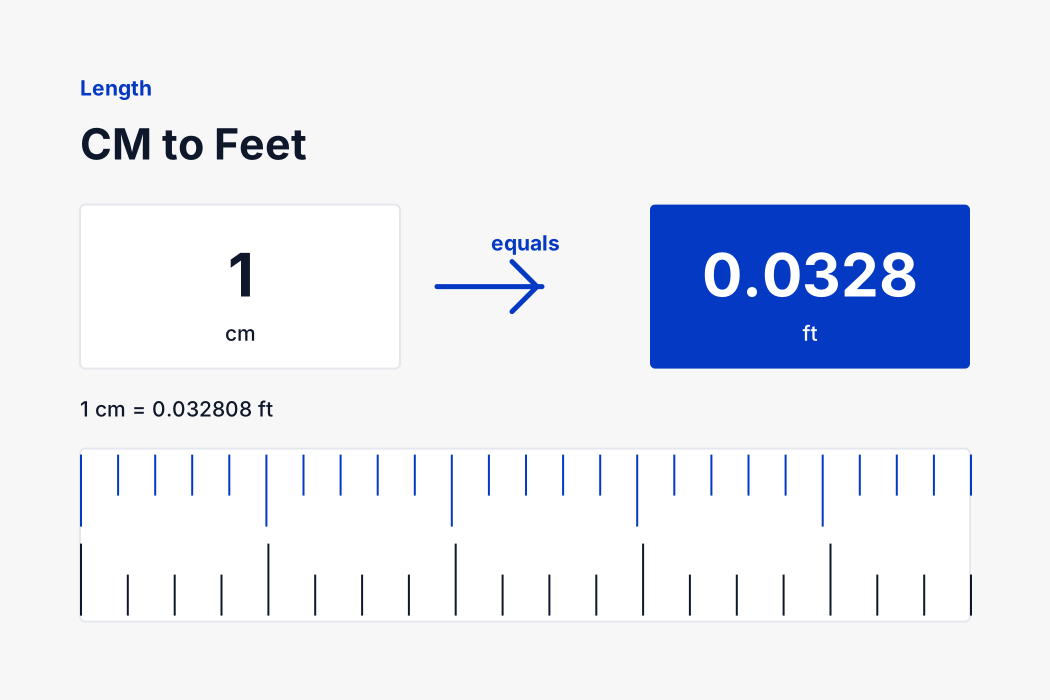
That is why converting centimetres to feet produces the awkward factor of 0.03280839895 rather than something you could do in your head. There is no underlying relationship between the two systems, only an agreed number that links them.
The agreement came in 1959, when the standards bodies of six English speaking countries fixed the yard at exactly 0.9144 metres. Every imperial length has been defined in metric terms ever since, which means the conversion carries no measurement error at all.
How much precision do you need for centimetres
A length conversion is only as good as the measurement behind it. A steel tape read to the nearest millimetre is accurate to about half a millimetre, and a tape read to the nearest sixteenth of an inch is accurate to about 0.8 of one. Quoting an answer in ft to six decimal places implies a confidence the measuring tool never gave you.
A practical rule is to keep one more decimal place than your measurement carried, run the arithmetic, then round the final answer back to the precision you started with. Rounding errors stop accumulating through a chain of calculations and the answer still reflects what you could actually measure.
Engineering is the exception. There the drawing states a tolerance and you work to it, so use the full factor of 0.03280839895 and round only at the very last step. A part machined to a rounded conversion can sit outside the tolerance band it was meant to hit.
Nothing is sent anywhere
This converter is a few lines of arithmetic running in your browser. There is no server call when you type, no account to create and no limit on how many times you use it. Open the page once and it keeps working with the connection switched off, which is genuinely useful on a building site, in a shop with no signal or on a plane.
That also means the page loads in well under a second and responds as fast as you can type. A converter that posts every keystroke to a server cannot do either of those things, and there is no reason a multiplication by 0.03280839895 should need one.
If you need the reverse direction, the swap button flips the two sides without reloading the page, so you can move between centimetres and feet as often as you like. The decimal places control sits beside it, and both settings apply immediately to whatever number is already in the box.
Checking the answer yourself
Every figure on this page can be verified by hand, which is the point of showing the formula and the factor rather than just printing a result. Take 180 cm, apply the formula above, and you should land on the same feet figure the converter gives.
If your own calculation differs in the last decimal place, the cause is almost always a rounded factor. Pocket calculators and spreadsheets often carry a shortened version, and over a large number that small difference becomes visible. The converter here uses the full value throughout and rounds only for display, so the number you copy is the number the definition gives.
Where a document, a form or a specification states its own conversion factor, use theirs rather than ours. Some industries deliberately work to a rounded figure for consistency, and matching the paperwork matters more than being marginally more precise than it.