Feet to CM

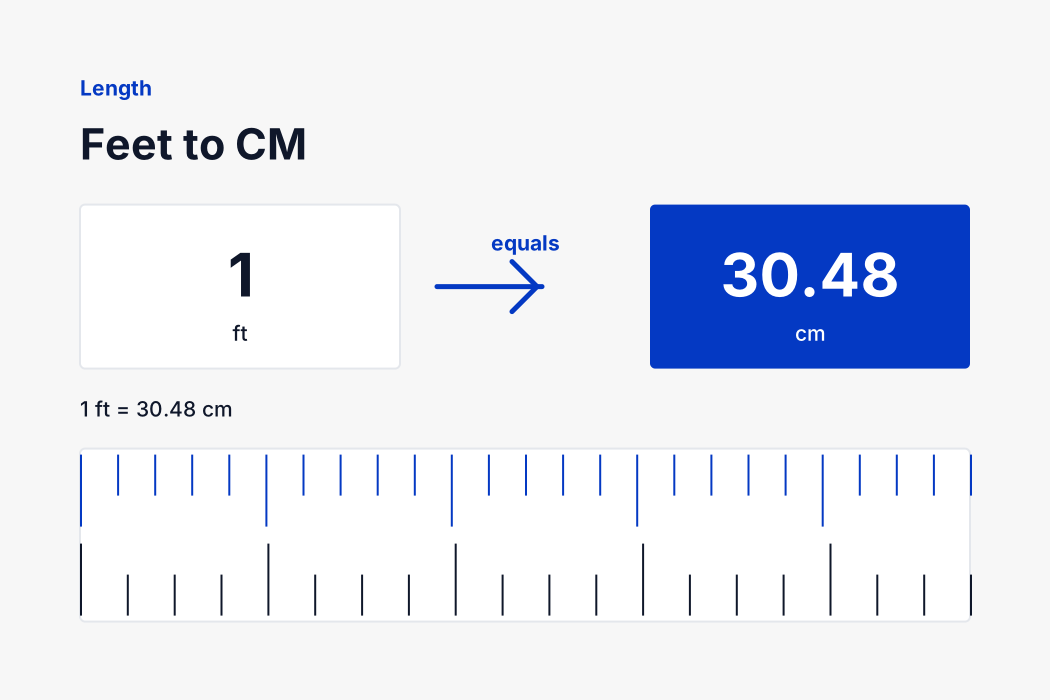
1 ft = 30.48 cm

Exact factor Nothing uploaded Works offline No sign-up
ft
cm

1 ft = 30.48 cm

Quick values

Most people asking this are converting a height

Feet to centimetres is overwhelmingly a height question. Someone has a height in feet and inches and needs it in centimetres for a form, a visa application, a medical record or a dating profile in a metric country.

The trap is that a height is two numbers, not one. Five foot nine is not 5.9 feet, it is 5.75 feet, because nine inches is three quarters of a foot and not nine tenths. Convert the inches to a decimal first by dividing by twelve, or convert the feet and the inches separately and add the results.

Five feet is 152.4 cm and nine inches is 22.86 cm, so five foot nine is 175.26 cm, which every passport office will round to 175.

A height chart on a wall marked in both feet and centimetres
How it works

Type, read, done

There is no convert button and no page reload. The answer updates on every keystroke.

1

Type your figure

Put a number of feet into the left box. Decimals, negatives and very large values all work.

2

Read the answer

The centimetres figure appears as you type, along with the full sentence underneath so you can copy it whole.

3

Adjust or reverse

Change the decimal places, tap a quick value, or press swap to convert centimetres back to feet.

The formula

One foot is twelve inches and one inch is exactly 2.54 centimetres, so a foot is exactly 30.48 centimetres.

cm = ft × 30.48

To go the other way: ft = cm ÷ 30.48

Worked through with a real number, 5 ft becomes 152.4 cm. The calculation at the top of the page runs the same arithmetic as you type, to as many decimal places as you ask for.

Feet to Centimetres conversion chart

Every value below is calculated with the exact factor rather than a rounded one, then displayed to 2 decimal places. Read it on screen or print the page, since the chart carries no scripts and needs no connection.

FeetCentimetresFeetCentimetres
1 ft30.48 cm6.5 ft198.12 cm
2 ft60.96 cm7 ft213.36 cm
3 ft91.44 cm8 ft243.84 cm
4 ft121.92 cm10 ft304.8 cm
5 ft152.4 cm12 ft365.76 cm
5.5 ft167.64 cm15 ft457.2 cm
6 ft182.88 cm20 ft609.6 cm

The values people look up most

These are the feet figures that get searched for by name, worked out with the exact factor rather than a rounded one.

  • 1 ft is 30.48 cm.
  • 3 ft is 91.44 cm.
  • 5 ft is 152.4 cm.
  • 6 ft is 182.88 cm.
  • 7 ft is 213.36 cm.
  • 10 ft is 304.8 cm.

Anything not on this list can be typed into the converter at the top of the page, which handles decimals, very large numbers and negative values without rounding until you ask it to.

Heights in feet and centimetres

These are the conversions people look up most, and every one of them is exact rather than rounded.

  • 5 feet 0 inches is 152.4 cm.
  • 5 feet 4 inches is 162.56 cm, close to the average adult woman's height in much of Europe.
  • 5 feet 7 inches is 170.18 cm.
  • 5 feet 9 inches is 175.26 cm.
  • 6 feet 0 inches is 182.88 cm, which is why 183 cm is the figure most people quote.
  • 6 feet 2 inches is 187.96 cm.

Outside height, the conversion shows up in room dimensions, ceiling heights on building plans and the length of cable or timber sold by the foot.

Two systems that were never meant to meet

The metric system was designed in one go, by committee, after the French Revolution. Every unit relates to every other by a power of ten and the metre was pinned to a measurement of the Earth itself. The imperial units were not designed at all. They accumulated over centuries from body parts, farming practice and royal decree, and were only tidied up long after they were in use.

That is why converting feet to centimetres produces the awkward factor of 30.48 rather than something you could do in your head. There is no underlying relationship between the two systems, only an agreed number that links them.

The agreement came in 1959, when the standards bodies of six English speaking countries fixed the yard at exactly 0.9144 metres. Every imperial length has been defined in metric terms ever since, which means the conversion carries no measurement error at all.

How much precision do you need for feet

A length conversion is only as good as the measurement behind it. A steel tape read to the nearest millimetre is accurate to about half a millimetre, and a tape read to the nearest sixteenth of an inch is accurate to about 0.8 of one. Quoting an answer in cm to six decimal places implies a confidence the measuring tool never gave you.

A practical rule is to keep one more decimal place than your measurement carried, run the arithmetic, then round the final answer back to the precision you started with. Rounding errors stop accumulating through a chain of calculations and the answer still reflects what you could actually measure.

Engineering is the exception. There the drawing states a tolerance and you work to it, so use the full factor of 30.48 and round only at the very last step. A part machined to a rounded conversion can sit outside the tolerance band it was meant to hit.

Nothing is sent anywhere

This converter is a few lines of arithmetic running in your browser. There is no server call when you type, no account to create and no limit on how many times you use it. Open the page once and it keeps working with the connection switched off, which is genuinely useful on a building site, in a shop with no signal or on a plane.

That also means the page loads in well under a second and responds as fast as you can type. A converter that posts every keystroke to a server cannot do either of those things, and there is no reason a multiplication by 30.48 should need one.

If you need the reverse direction, the swap button flips the two sides without reloading the page, so you can move between feet and centimetres as often as you like. The decimal places control sits beside it, and both settings apply immediately to whatever number is already in the box.

Checking the answer yourself

Every figure on this page can be verified by hand, which is the point of showing the formula and the factor rather than just printing a result. Take 10 ft, apply the formula above, and you should land on the same centimetres figure the converter gives.

If your own calculation differs in the last decimal place, the cause is almost always a rounded factor. Pocket calculators and spreadsheets often carry a shortened version, and over a large number that small difference becomes visible. The converter here uses the full value throughout and rounds only for display, so the number you copy is the number the definition gives.

Where a document, a form or a specification states its own conversion factor, use theirs rather than ours. Some industries deliberately work to a rounded figure for consistency, and matching the paperwork matters more than being marginally more precise than it.

FAQ

Feet to CM

The questions people ask most about this conversion.

Exactly 30.48 centimetres, because a foot is twelve inches and an inch is exactly 2.54 cm.

175.26 cm. Convert the five feet to 152.4 cm, the nine inches to 22.86 cm, then add them together.

Because a foot has twelve inches, not ten. Nine inches is 0.75 of a foot, so five foot nine is 5.75 feet as a decimal.

Not quite. Six feet is 182.88 cm. Almost every form rounds it to 183, and the difference of just over a millimetre never matters in practice.

Yes, completely. There is no account, no usage limit and no paid tier. The conversion runs in your browser, so it costs us nothing to give you and nothing to run.

It uses the exact defined factor of 30.48 rather than a rounded one, and JavaScript carries about fifteen significant digits. The precision you see is set by the decimal places control, not by any limit in the maths.

Yes. Once the page has loaded, every conversion happens on your device. You can switch off your connection and the converter above will carry on working normally.

No. Nothing you type is transmitted, logged or stored. The arithmetic runs entirely in the page and the values disappear when you close the tab.

Press the swap button between the two boxes. It reverses the direction in place, keeps the number you were looking at and applies the inverse formula.

Yes. The layout stacks on a narrow screen, the number fields open a numeric keypad, and the whole page is a few kilobytes so it loads on a slow mobile connection.

Yes. Height in cm, height converter and height in feet to cm: the same conversion, written the way different people write it, and this page does all of them.

Need a different conversion?

Over a hundred free tools, all running in your browser. Nothing is uploaded and nothing is capped.