Speed limits and the units they are posted in
Only a handful of countries still post speed limits in miles per hour: the United States, the United Kingdom and a few smaller territories. Everywhere else uses kilometres per hour, which is why a hire car abroad can be genuinely confusing before you notice which scale the dial is reading.
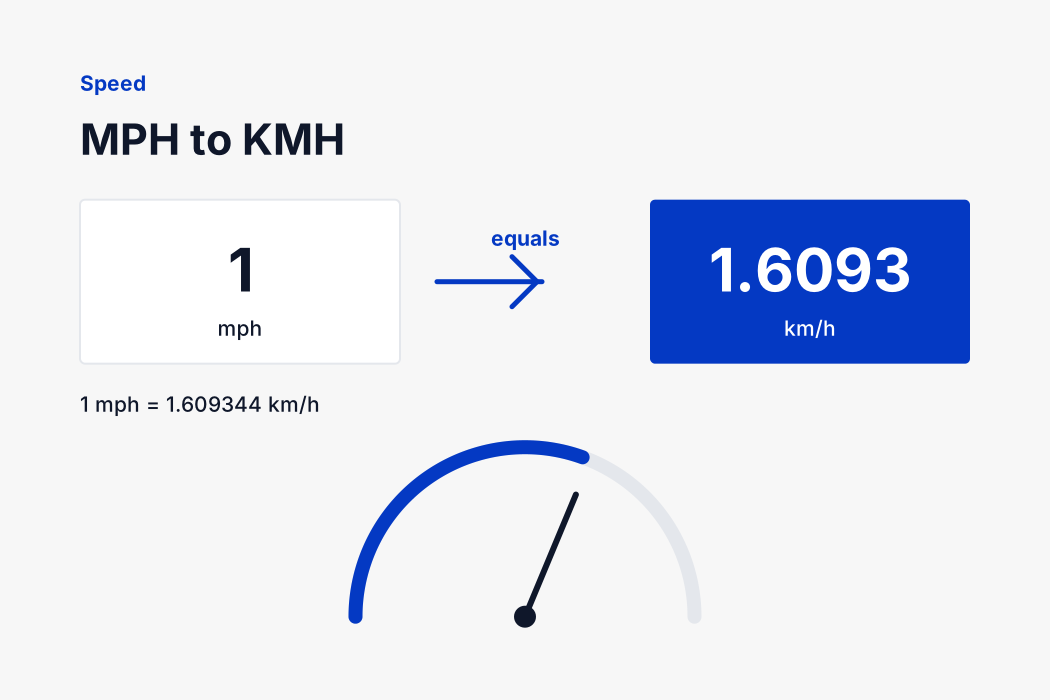
Most speedometers carry both, with the secondary scale printed inside the primary one in smaller figures. Converting miles per hour to kilometres per hour tells you what the other ring means, and the factor of 1.609344 is the same one that converts the distance, because the hour cancels out on both sides.
Aviation and shipping use a third unit entirely. The knot is one nautical mile per hour, which is 1.852 kilometres per hour, and it survives because a nautical mile is one minute of latitude, which makes navigation charts far easier to read.
Reading a converted miles per hour figure correctly
Speed conversions are exact, but the numbers are usually used to make a judgement rather than a calculation, and that is where care is needed. A limit that converts to 64.37 is not a limit of a round number in the other system, and driving to the converted figure is not the same as driving to the posted one.
Speedometers add another layer. Regulations in most countries let a speedometer read high but never low, so a dial showing a given speed may mean anything from six percent below it to exactly it. Satellite navigation gives a truer figure, since it measures distance over time directly rather than counting wheel rotations against an assumed tyre size.
For anything recorded rather than driven to, such as a sports measurement or a vehicle specification, use the full factor of 1.609344 and round only when you publish the number.
Nothing is sent anywhere
This converter is a few lines of arithmetic running in your browser. There is no server call when you type, no account to create and no limit on how many times you use it. Open the page once and it keeps working with the connection switched off, which is genuinely useful on a building site, in a shop with no signal or on a plane.
That also means the page loads in well under a second and responds as fast as you can type. A converter that posts every keystroke to a server cannot do either of those things, and there is no reason a multiplication by 1.609344 should need one.
If you need the reverse direction, the swap button flips the two sides without reloading the page, so you can move between miles per hour and kilometres per hour as often as you like. The decimal places control sits beside it, and both settings apply immediately to whatever number is already in the box.
Checking the answer yourself
Every figure on this page can be verified by hand, which is the point of showing the formula and the factor rather than just printing a result. Take 70 mph, apply the formula above, and you should land on the same kilometres per hour figure the converter gives.
If your own calculation differs in the last decimal place, the cause is almost always a rounded factor. Pocket calculators and spreadsheets often carry a shortened version, and over a large number that small difference becomes visible. The converter here uses the full value throughout and rounds only for display, so the number you copy is the number the definition gives.
Where a document, a form or a specification states its own conversion factor, use theirs rather than ours. Some industries deliberately work to a rounded figure for consistency, and matching the paperwork matters more than being marginally more precise than it.