Land, floors and the units they use
Area units almost always come from a length unit squared, but the ones people actually use for land came from farming rather than geometry. The acre was a day's ploughing, the hectare was invented later to give the metric system a round land unit at ten thousand square metres.
For buildings, the square foot dominates wherever imperial units survived and the square metre everywhere else. India uses both at once, which is why a listing may quote square feet while the registry document quotes square metres, and both figures describe the same floor.
The one thing to check before converting is what the area covers. Two listings can differ by thirty percent on identical homes simply because one measured inside the walls and the other included a share of the lobby and stairwell.
Why an area error is bigger than a length error
An area conversion squares the underlying length factor and it squares your error along with it. Round the length factor by one percent and the area is out by roughly two. On a two thousand sq ft property that is forty sq ft, which is a small room.
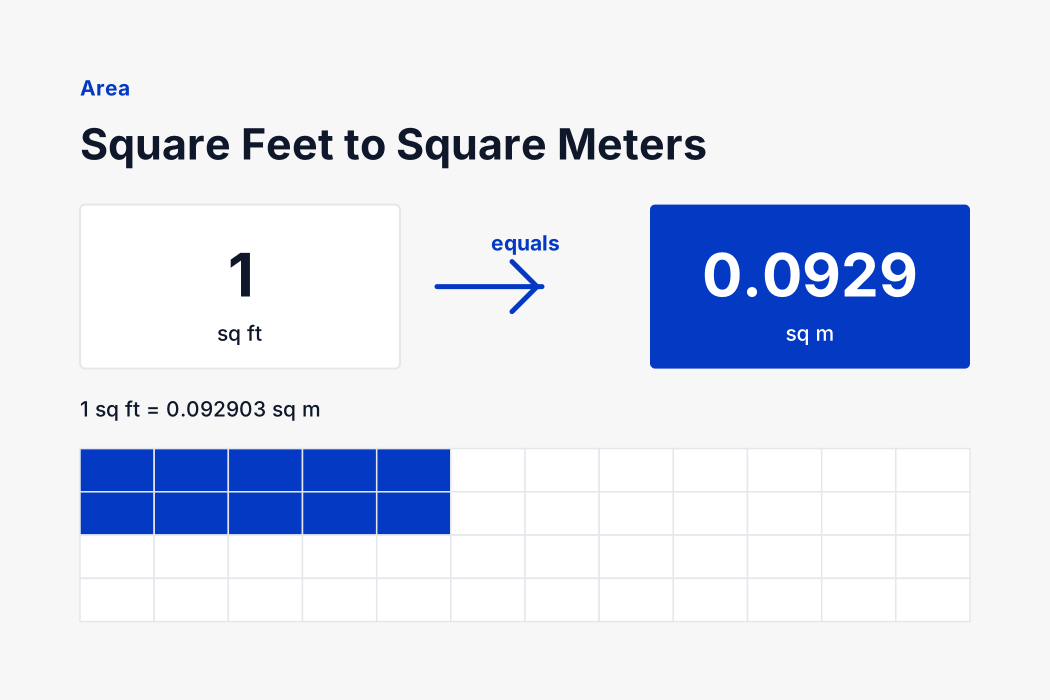
This is why the converter uses the full factor of 0.09290304 rather than the familiar rounded one. It also means you should convert the total area once rather than converting each dimension and multiplying, since the second method rounds twice.
The larger problem in property is definitional rather than mathematical. Carpet area, built up area and super built up area are three different measurements of the same home and they can differ by thirty percent. Converting square feet to square metres correctly does nothing to make two listings comparable if they are quoting different areas.
Nothing is sent anywhere
This converter is a few lines of arithmetic running in your browser. There is no server call when you type, no account to create and no limit on how many times you use it. Open the page once and it keeps working with the connection switched off, which is genuinely useful on a building site, in a shop with no signal or on a plane.
That also means the page loads in well under a second and responds as fast as you can type. A converter that posts every keystroke to a server cannot do either of those things, and there is no reason a multiplication by 0.09290304 should need one.
If you need the reverse direction, the swap button flips the two sides without reloading the page, so you can move between square feet and square metres as often as you like. The decimal places control sits beside it, and both settings apply immediately to whatever number is already in the box.
Checking the answer yourself
Every figure on this page can be verified by hand, which is the point of showing the formula and the factor rather than just printing a result. Take 2,000 sq ft, apply the formula above, and you should land on the same square metres figure the converter gives.
If your own calculation differs in the last decimal place, the cause is almost always a rounded factor. Pocket calculators and spreadsheets often carry a shortened version, and over a large number that small difference becomes visible. The converter here uses the full value throughout and rounds only for display, so the number you copy is the number the definition gives.
Where a document, a form or a specification states its own conversion factor, use theirs rather than ours. Some industries deliberately work to a rounded figure for consistency, and matching the paperwork matters more than being marginally more precise than it.