Merge PDF

Combine several PDFs into one in your browser, with the text still text. Nothing is uploaded.

Free, no limit Nothing uploaded No watermark Works on mobile

Drop your PDFs here

Drop as many PDFs as you like. Nothing is uploaded.

Choose files

Several documents, one file, nothing rebuilt

Merging PDFs should be a copying job and here it is one. The pages of each document are lifted out and appended to a new file with their text, fonts, vector art and images untouched. What comes out is the same pages in a different container, not a picture of them.

That matters because the alternative is common and quietly destructive. A merger that renders every page to an image produces a file that looks identical and has lost everything underneath: nothing selectable, nothing searchable, and a size several times larger.

Drop in as many documents as you like, put them in the order you want with the arrows, and download one PDF. None of it is uploaded.

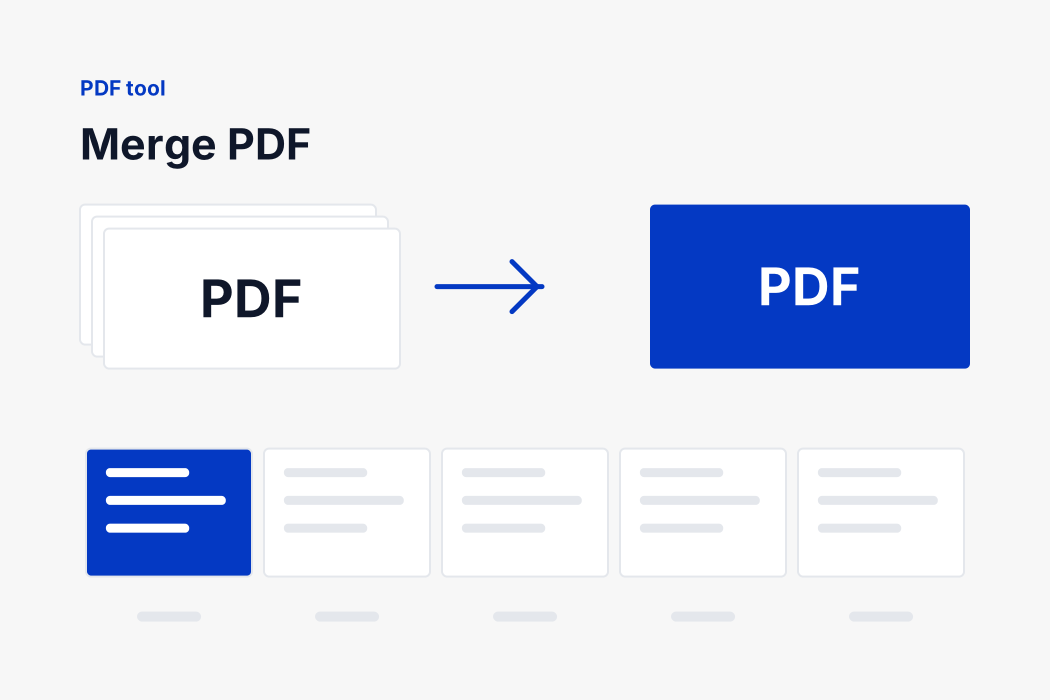
Several PDF documents being combined into one
How it works

Three steps, no upload

Your browser reads the images and writes the document. There is no queue and no waiting.

1

Add your PDF

Drop the document onto the tool. It is opened where it sits and never uploaded.

2

Read what it says

The page checks whether your file is a scan or real text, and tells you what compressing will cost.

3

Compress and download

Both sizes are shown, before and after, so you can see what you actually got.

How pages are moved without being redrawn

A PDF is a set of numbered objects and a table saying where each one starts. A page is one of those objects, and it points at the others it needs: the fonts it uses, the images it draws, the vector paths that make up its text and its lines.

Copying a page properly means following every one of those references and bringing along whatever it points at, then renumbering all of it so the new document is internally consistent. Do it right and the page arrives whole. Do it wrong and you get a file that opens with the text missing, or does not open at all.

That work is done here by pdf-lib, an MIT licensed library for reading and writing PDFs. It is served from this site rather than fetched from a content network, so the page makes no request to anybody else, and it runs in your browser. Your document is not uploaded, and because the pages are copied rather than rendered, the text in the result is still text you can select, search and copy.

What happens to each part

Part of the documentIn the merged file
Text and fontsCarried across intact. Still selectable and searchable.
ImagesCopied as they are, at their original quality.
Vector drawingsCopied as geometry, so they stay sharp at any zoom.
Page size and orientationKept per page. Mixed sizes merge without being forced to match.
Links within a pageUsually kept.
Interactive form fieldsOften lost. Two documents cannot both own the form.
Bookmarks and the outlineNot carried over.
Digital signaturesBroken, necessarily. A signature covers one exact file.

The last two are worth reading twice. If the documents you are merging are signed, merging them invalidates the signatures, because a signature is a statement about one specific set of bytes and those bytes are about to change. That is not a fault in this tool; it is what a signature means.

Why none of this leaves your device

Think about what people actually turn into PDFs. Passports and visas. Bank statements for a loan application. Degree certificates. Rental agreements with a signature on them. Medical letters. Almost every one of those is a document you would not hand to a stranger.

An online converter that works the ordinary way asks you to do exactly that. Your file goes to a server you know nothing about, in a country you were not told, and is processed and stored for some period described in a policy nobody reads. Most of those services are honest. You have no way of checking which ones.

This page removes the question. The conversion runs in your browser, using the image decoder your browser already has and a PDF writer that is part of the page. No file is transmitted, so there is nothing on our side to store, scan, sell or lose. You can disconnect from the internet after the page loads and it will still work, which is the simplest proof there is.

One thing to be straight about: copying pages between documents uses pdf-lib, an open source library published under the MIT licence. It is not our code. We serve our own copy of it from this domain rather than loading it from a content network, so opening this page tells nobody else that you did, and it runs entirely in your browser. The file still goes nowhere.

Before you merge

  • Order is yours to set. Documents are appended in the order shown, and the numbering tells you what that is. Move them before you merge.
  • Every page of every document goes in. To take only some, split first and merge afterwards.
  • Page sizes can differ and that is fine. An A4 document and a Letter one merge into a file with both, each page keeping its own size.
  • Form fields and annotations may not survive. Pages are copied faithfully, but an interactive form is data held at the document level, and merging two documents cannot keep two of those.
  • The result is the sum of the parts. Merging does not compress; a 4 MB and a 6 MB document make a 10 MB one.

What people merge PDFs for

Applications, almost always. A form that accepts one file when what you have is a passport, a photograph, two certificates and a bank statement. Also expense claims, scanned chapters, and contracts signed in pieces by different people on different days.

How this compares with the alternatives

An online tool that uploads

The usual arrangement and the one to think twice about here. To merge your documents they need your documents, and the documents people merge are contracts, statements and applications. Most of those services are honest and you have no way of telling which.

Preview on a Mac

Genuinely capable and already installed: drag pages between thumbnails, delete the ones you do not want, save. If you are on a Mac and the job is small, use it. This page exists for Windows, for phones, and for the times you would rather not open a file manager.

Acrobat and other paid editors

More powerful in every direction, and the right tool if you also need to edit, sign, redact or fill in forms. Also a subscription for something most people need twice a year.

Printing to PDF

A workaround that appears to work. It flattens everything to a fresh document, which usually means the text stops being text and the file gets larger. It is the rendering approach, and it is exactly what this page avoids.

If something does not look right

It says the PDF is password protected

Then it is. A locked document cannot be opened without its password by anything, here or elsewhere. Open it in a reader, enter the password, save an unprotected copy, and use that.

The form fields have gone

An interactive form belongs to the document rather than to a page, so it cannot survive being combined with another document that has its own. If the answers matter, flatten the form first: print it to PDF from your reader, which turns the filled values into ordinary page content.

The pages are in the wrong order

Files are listed in the order the browser handed them over, which for a multiple selection is not always the order you clicked. Every row is numbered and has arrows, so set the order before you press the button rather than after.

The file is as big as everything added together

Because it is. Merging copies pages; it does not compress them. Nothing here makes a PDF smaller, and any tool that claims to while keeping the text is either removing something or not doing what it says.

Nothing happened when I pressed the button

Merging needs at least two readable documents, and splitting needs one. If a row is marked in the list as unreadable it is not counted. A very large document can also take a few seconds before anything appears.

A signed document now says the signature is invalid

That is correct and unavoidable. A digital signature certifies one exact file, and a merged file is a different one. Sign after merging, never before.

Free, with no account and no watermark

No sign-up, no daily limit, no watermark and no page cap. There is no paid tier holding anything back, because the work happens on your computer rather than on a server we have to pay for.

The files keep sensible names. Splitting gives you your own filename with the page number added and zero padded; merging gives you one file called merged.pdf. Nothing is added to the document itself.

If you need the result smaller, compress the images before they become a PDF, or split out the pages you actually need. Our other PDF tools cover turning images into a document and taking a document back to images, all in the same way: on your machine, with nothing uploaded.

FAQ

Merge PDF

The questions people ask most about this conversion.

No. Pages are copied with their text, fonts and images intact. Nothing is re-rendered, so nothing is lost.

Yes. Each document has an up and a down arrow, and the numbering shows exactly the order the merged file will be in.

Only your device's memory. Dozens of ordinary documents are no trouble; a hundred large scans will take a moment and a lot of memory.

No. They are read and combined inside your browser and nothing is transmitted anywhere.

No. Merging is not compressing: the result is about the size of the parts added together.

The pages come across, but interactive form fields are held at the document level and generally do not survive a merge. Flatten the form first if the answers matter.

Completely, with no limit on how many images you convert or how large they are. There is no account, no paid tier and no watermark, because the conversion runs on your device and costs us nothing to provide.

No. There is no app, no extension and no plugin. The page you are on is the whole program, and it works the same on Windows, macOS, Android and iPhone.

No. There is no watermark, no logo and no added page, however many images you convert.

Yes, on both iPhone and Android. Pick images straight from your gallery and the PDF is saved to your downloads like any other file.

No. This page makes a PDF out of images. Reading an existing one needs a full PDF renderer, which is a large program we would have to load from somewhere else, and that would break the promise that nothing leaves your device.

Need a different conversion?

Over a hundred free tools, all running in your browser. Nothing is uploaded and nothing is capped.