WebP to PNG

Convert WebP to PNG in your browser. Nothing is uploaded.

Free, no limit Nothing uploaded No watermark Works on mobile

Drop your WebP files here

Drop as many WebP files as you like. Nothing is uploaded.

Choose files

The right choice when the image has transparency

If your WebP has a transparent background, PNG is the format to convert to and JPG is the one to avoid. JPG has no alpha channel and would replace the transparency with a solid colour, which turns a logo into a logo on a white rectangle.

PNG keeps the alpha channel intact, pixel for pixel. It is also lossless, so this conversion adds no compression damage of its own: whatever the WebP contained is what the PNG will contain.

The file will get bigger, sometimes considerably, because PNG cannot compress as tightly as WebP. For a logo or an icon that is rarely a problem. For a photograph it can be, and JPG may suit you better if there is no transparency to protect.

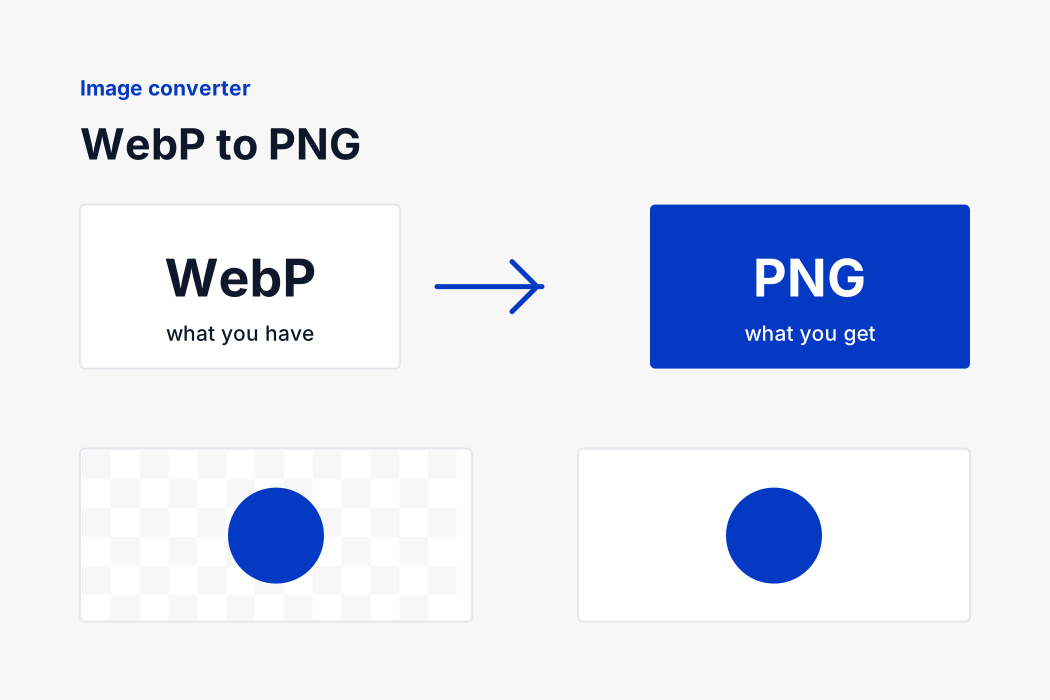
A WebP image with transparency converted to a lossless PNG
How it works

Three steps, no upload

Your browser does the decoding and the encoding. There is no queue and no waiting.

1

Add your files

Drop in as many WebP files as you like, or pick them from your device.

2

Check the settings

There is nothing to set. The output is PNG, which is what this page is for.

3

Download

Each file is ready straight away, with its old and new size shown. Take them one by one or as a zip.

WebP and PNG, side by side

WebP, what you have

Google's replacement for both JPG and PNG on the web. Roughly thirty percent smaller than JPEG at the same quality, and far smaller than PNG for flat graphics, while still supporting transparency and animation.

Where it works: Every current browser. Outside the browser it is patchy: many upload forms, print tools and older desktop applications still refuse it.

PNG, what you get

Lossless, so every pixel is stored exactly, with a full alpha channel for transparency. Built as a free replacement for GIF and now the standard for logos, screenshots and anything with sharp text.

Where it works: Everything. Support is as universal as JPG, and it is the only one of the two that can carry a transparent background.

WebP is lossy and PNG is not, so the conversion itself discards nothing. What it cannot do is recover detail the WebP already lost, which is why the result looks the same rather than better.

Both formats support an alpha channel, so a transparent background survives the conversion exactly as it was.

An animated WebP converts to its first frame only, because PNG holds a single still image.

How these formats compare

The four things that decide which format you should be using, for every format involved on this page.

FormatCompressionTransparencyAnimationIntroduced
WebPLossyYesYes2010
PNGLosslessYesNo1996
JPGLossyNoNo1992

Age matters more than it looks. A format introduced in the 1990s is read by everything ever made, and one introduced in the last ten years is read by browsers and very little else. That single fact explains most of the reasons people convert images at all.

What happens to the file size

Expect the file to grow, often by two to five times. PNG is lossless and has to store every pixel, while the WebP had already been compressed down. Growth here is the format working as intended, not a fault.

Two things drive the number more than the format does. The first is the content: a photograph of a landscape holds far more unique detail than a screenshot of a spreadsheet, and detail is what costs bytes. The second is the pixel dimensions, which no format conversion changes. A twelve megapixel photograph is twelve megapixels whatever container it sits in.

If you need to hit a specific size rather than simply make the file smaller, converting is the wrong tool. Our image compressor takes a target in kilobytes and finds the highest quality that fits under it, which is what upload forms with a stated limit actually require.

PNG or JPG, deciding quickly

Both open everywhere. The choice comes down to what is in the picture.

  • Transparent background, choose PNG. This is the only one of the two that can keep it.
  • Logo, icon, diagram or screenshot, choose PNG. Sharp edges and flat colour are what PNG handles best.
  • Photograph with no transparency, choose JPG. The file will be several times smaller and the difference will not be visible.
  • You will edit it further, choose PNG, because repeated saving costs nothing in a lossless format.

Everything runs on your device

There is no upload. Your browser decodes the file, draws it onto a canvas in memory and encodes it again in the format you asked for. The picture never travels anywhere, no server sees it, and nothing is stored or logged.

That matters most for the images people actually convert: identity documents, medical scans, private photographs, unreleased design work. On a conventional converter every one of those is copied to a machine you do not control, kept for some period you are not told about, and processed by software you cannot inspect.

It is also simply faster. There is no queue, no upload wait and no download wait, so a large batch finishes in the time it takes to read this paragraph. The only real limit is your device's memory, and a modern phone handles dozens of full resolution photographs without difficulty.

Your filename is kept

The converted file keeps the name you gave it, with only the extension changed. Nothing is appended, no brand is inserted and no counter is added. These files get uploaded straight into forms that sometimes check the name, and an unexpected one is one more thing that can be rejected for no good reason.

There is no watermark either, at any size, on any number of files. A watermark on a free converter exists to sell you the paid version, and we would rather not have that conversation with you at all.

Converting several files at once

Drop as many files as you like. Each one is converted separately and appears in the list with its original size, its new size and the difference between them, so nothing about what happened is hidden from you.

Download them one at a time, or use Download all to take the whole set as a single zip. The archive is built in your browser too, from the files already sitting in memory, so it costs one click and no waiting. Images are already compressed, so the zip stores them rather than compressing them again, which would only make the file larger.

If a file cannot be read, that row says so and the rest carry on. One awkward file in a folder of fifty does not stop the other forty nine.

What happens to the metadata

The conversion decodes the picture and encodes it again, so the embedded metadata does not travel with it. That includes EXIF data: the camera model, the exposure settings, the date, and on a phone photograph the GPS coordinates of wherever it was taken.

For most people that is a benefit rather than a loss. A photograph taken at home and uploaded to a public listing carries the location of your home inside it unless something strips it, and very few sites do. Converting the file removes it as a side effect.

If you actually want the metadata kept, for a photography portfolio or a copyright claim, this is the wrong tool and you should keep the original alongside the converted copy. Colour profiles are handled the same way: the image is converted into the standard sRGB space that browsers and the web use, which is right for anything published online and wrong for a print workflow that depends on a wider profile.

FAQ

WebP to PNG

The questions people ask most about this conversion.

Yes, completely. Both WebP and PNG store an alpha channel, so transparent areas stay transparent.

No. PNG is lossless, so the PNG contains exactly what the WebP decoded to. Any loss already present from the original WebP encoding stays as it is.

PNG compresses losslessly and WebP does not have to, so WebP is far more efficient. Two to five times larger is normal for a photograph.

Only if the image has no transparency and you want a smaller file. If there is a transparent background, JPG will fill it with white.

Completely, with no limit on how many files you convert or how large they are. There is no account, no paid tier and no watermark, because the conversion runs on your device and costs us nothing to provide.

No. Your browser decodes and re-encodes the image in memory on your own machine. Nothing is transmitted, nothing is stored and nothing is logged. You can disconnect from the internet after the page loads and it will still work.

No. There is no watermark, no logo and no added border, whatever the file size and however many you convert.

Yes. Only the extension changes, so a file called scan-final.webp becomes scan-final.png. Nothing is added to the name.

Yes. Drop a whole folder in and each file is converted separately, then download them individually or take the entire set as one zip built in your browser.

Yes, on both iPhone and Android. The layout adapts to a narrow screen and the conversion uses the same browser image pipeline your phone already relies on.

Need a different conversion?

Over a hundred free tools, all running in your browser. Nothing is uploaded and nothing is capped.